calculator
4. Doing more calculations using the calculator
The volume of timber (in cubic meters) contained in a log with a length of  metres and a distance around its middle of
  metres is determined by the formula
If you take a log measuring 1.5 meters, with a distance between 92 and 93 cm, this becomes
In this section , we will look at the various ways that can be used to assess this , and other more complex expressions using different functions on your calculator. While the initial method that we will discuss within Activity 9 - is the easiest to apply to this simple formula It is also useful to consider how you could employ different calculator functions in the event that you encounter more complex expressions to analyze.
The formula for the volume of wood requires the value of  . You can input an approximate value using your fingers however, this takes a lot of time and could lead to error. The calculator provides an approximate value included which is determined by this key sequence

 .
.
The key is located on the bottom side of the row that is the Keypad.
Activity 9: Using the fraction key
The most obvious method for making calculations 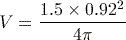 is to enter it as fractions in your calculator.
What is the key sequence that is required for the correct answer to 3 significant figures?Reveal answer
Another method to perform the calculation for Activity 9.9 would be to utilize key.  key.
key.
Activity 10 Using the key
You will not obtain the right answers to the equation
If you are typing
to your calculator and press  . Why do you think this is? Add a bracket into the expression that contain the / symbol so that it will give an accurate answer. Enter the formula into your calculator and check that you get the exact answer that you did in the previous activity above.Reveal answer
4.1 Reusing an earlier result
Another alternative to the calculation is to find the denominator first and then multiply the numerator by this.
You can write down the answer to the second part of the calculation on a piece of paper and enter it into the calculator and then enter it again. However, it is possible to make an error , either in recording the number or entering that number into your calculator. The best option is to use the fact that the calculator stores the last calculated answer which is then included in the subsequent calculation by pressing the  keypad on the bottom of the keyboard.
Remember it is important to note that this key can only store the results of your previous calculation.
Activity 11 Bottom First!
Utilize your calculator to calculate the value of the denominator of  , then complete the calculation by finding out the value from
  the three important figures.Reveal the solution
4.2 Utilizing the calculator memory
Another variation of the technique is to break down your calculation in two parts, and then utilize the memory functions used by calculator memory functions calculator and store the results of the first part. The calculator memory functions are especially useful when you need to calculate the sum of several variables that share a common portion. This common part must be entered once, and it can be used multiple times afterward. As an example, you could rewrite the formula for the quantity of wood within the log.
we can see that regardless of the value in as well and, this formula requires that we use the values of  . If we wanted to determine the volume of wood in a number of different logs it would be feasible to calculate its value one time, then store it in memory , then use this amount in subsequent calculations.
The calculator has several different memories. The first memory we'll look at is the 'M' memory, which is accessed using the  key (and its functions) at the bottom right-hand edge of the key.
Before you use your calculator memory, it's an ideal practice to remove any data previously stored within the calculator by using this key sequence (CLR) (Memory) (Yes) .
This clears all memories of the calculator memory.
To store the outcome of the expression you just calculated(i.e. the answer is displayed in the screen's output calculator screen) in the 'M' calculator memory, use to store the result using the key sequence  (STO) (M). In this case, we're using the second function of the (or recall) button, called "STO" (or store). After selecting the store function the next step is to tell the calculator what memory the data is to be stored in. The memory's name is red on a few or all calculator keys, and the 'M' memory is obtained by pressing the key. It is possible to read the key sequence to mean'store the current result in the"M" memory'.
When (or (STO)) is activated, the display indicator (RCL) (or STO) is shown on the screen to indicate it is the calculator is waiting for what memory to retrieve (store) this value (in).
To display the current contents of the 'M' memory press (M). The memory value can also be used as part of a later calculations by inserting 'letter M' into the appropriate place in the expression by using  (M). For example, to find the square of the amount currently stored in the 'M' memory , we can use to use the key sequence (M) .
If there is a value stored in the memory of 'M the indicator of the display is displayed at the top in the display.
Activity 12: Memory use
The value of your calculator's memory 'M' of the calculator and then use the stored value to determine  to 3 important figures.Reveal the answer
4.3 Other 'M' memory operations
The data stored in memory 'M' can also be changed by subtracting or adding the result of a different calculation:
-
In order to add the result of the most recent calculation the current value in memory, press .
-
To subtract the result of the latest calculation from the one currently in the memory, you can use an algorithm called the Key Sequence (MM -).
Expressions may also be stored as part of, coupled to, or removed from memory at the same time as the expressions are evaluated using replacing the at the end of a calculation with one of the memory access sequences. To calculate, for instance, and then store the results straight into the memory, utilize this key sequence (STO) (M).
To remove the memory in the 'M, simply store the value zero by via the key sequence (STO) (M).
4.4 Other memories
The calculator also has 6 other memoriesthat are labeled as "A," "B," ('C'), 'D", "X" and "Y' to be accessed with several keys located in that lower part of function keys of the calculator. The memory's name is printed in red on top of the key that accesses it.
They can be utilized exactly the same way as the memory known as 'M' but there aren't alternatives to the 'add to memory' ( ) as well as'subtract from memory' ( (M+)) functions, and no display indicators.
5 Scientific notation for the back of your calculator
Calculating numbers using scientific notation on your calculator
If the output of any calculation results in one that is a number that is greater than or equal to  (i.e. ) The calculator will automatically display the result in scientific notation. For example Calculating
  provides the answer
 ,
,
The calculator screen in the same way as it's in this article.
Small numbers are also shown with scientific notation. However, how small a number is required to be for this to happen will depend on the mode in which the calculator is operating in.
-
'Norm 1" mode employs in-depth scientific terminology for any number lower than
 but greater over
  .
.
-
"Norm 2 Mode' uses science-based notation when referring to any number less that
 but greater by
  .
.
"Norm" is a short form for "normal".
Within Activity 1 you will have already changed your calculator to use Norm 2 mode, and we recommend that for the time being, you use this. To switch the mode, you can use keys (SETUP) (Norm) which is followed by (for Norm 1) or (for the Norm 2 mode)).
You can also set your calculator to display all results using scientific notation with the set number of relevant numbers by using an appropriate key sequence (SETUP) (Sci) and then followed by the number of significant figures required for example . When your calculator is set to display in this manner the display indicator SCI is displayed on right at the very top. To remove this setting, you can use one of the key sequences given below to go back into a Normal mode.
Comments
Post a Comment